
Spanish and Portuguese Speaking Working Group
Grupo de Habla Española y Portuguesa de la ISFG / Grupo de Línguas Espanhola e Portuguesa da ISFG.
PROFICIENCY TESTING
UPCOMING ACTIVITIES OR MEETINGS
Next GHEP-ISFG meeting
GHEP-OS Online School
PREVIOUS MEETINGS
2024
The 2024 annual GHEP-ISFG meeting was held in Salta, Argentina, from 4 to 6 of June, 2024. The Local Organizing Committee, represented by Nidia Modesti (Institute of Forensic Genetics, Córdoba, Argentina), in collaboration with the SAGF (Argentinean Society of Forensic Genetics), hosted a wonderful event, with over 130 people participating. All available information is on the Meeting website- DNA databases and
- Identification of missing persons in Argentina.
- Following in the footsteps of the Native Americans through South America - Analysis of distribution patterns of male sublineages of the haplogroup Q - Vania Pereira et al.
- Kinship Analyses Involving Individuals with Klinefelter Syndrome – Marisa Faustino et al.
- Machine Learning models for iris color prediction in the population of Buenos Aires (Argentina) – Cecilia Catanesi et al.
- A Perspective of the Autosomal Ancestry and Maternal Lineage of the Montubios of the Rural Communities of the Province of Santa Elena, Ecuador – Katherine Barrionuevo Pérez et al.
- Mito-genomes in native populations from Ecuador: informative power and discrimination of haplogroups B4b – Rodrigo Flores-Espinoza.
- Sensitivity and specificity of DIP-STR polymorphisms used to resolve highly unbalanced DNA mixtures – Sofía Angeletti et al.
2023
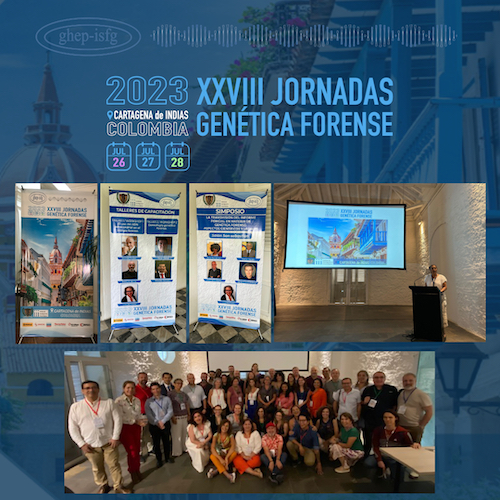
The 2023 meeting of the Spanish and Portuguese-Speaking Working Group of the ISFG (GHEP-ISFG) was held in Cartagena de Indias, Colombia, on July 26-28, 2023.Hosted by Beatriz Martínez and colleagues from the Instituto de Investigaciones Inmunológicas, University of Cartagena, over 90 participants were present in this event, which included various topics, namely:
- 2 Symposiums on the scientific and legal aspects of expert reports in the context of Forensic Genetics, one more oriented to geneticists and the other to magistrates;
- Two full-day workshops on the use of mitochondrial DNA in the forensic field and on forensic genetic genealogy;
- A half-day presentation/discussion of the GHEP-ISFG/INTCFM Proficiency Test (EIADN 2023);
- A mini-symposium on DVI;
- The presentation/discussion of the Advanced Theoretical Challenges (ATC 2023), and
- The GHEP-ISFG General Assembly for GHEP members only.
You may find the detailed program here and more details on the GHEP-ISFG website
President
Pedro A. Barrio Caballero
Servicio de Biología. Departamento de Madrid
Instituto Nacional de Toxicología y Ciencias Forenses (INTCF)
Ministerio de Justicia
C/ José Echegaray 4
E-28232 Las Rozas de Madrid, Madrid, Spain
pedrobarrio@ghep-isfg.org
Servicio de Biología. Departamento de Madrid
Instituto Nacional de Toxicología y Ciencias Forenses (INTCF)
Ministerio de Justicia
C/ José Echegaray 4
E-28232 Las Rozas de Madrid, Madrid, Spain
pedrobarrio@ghep-isfg.org
Vice President
Leonor Gusmão
DNA Diagnostic laboratory (LDD)
State University of Rio de Janeiro (UERJ)
Rua São Francisco Xavier, 524. Maracanã
20550-900 Rio de Janeiro (RJ) Brasil
Tfno: +55 2123342183
leonorbgusmao@gmail.com
DNA Diagnostic laboratory (LDD)
State University of Rio de Janeiro (UERJ)
Rua São Francisco Xavier, 524. Maracanã
20550-900 Rio de Janeiro (RJ) Brasil
Tfno: +55 2123342183
leonorbgusmao@gmail.com
Secretary GHEP-ISFG
Manuel Crespillo Márquez
Servicio de Biología. Departamento de Barcelona
Instituto Nacional de Toxicología y Ciencias Forenses (INTCF)
Ministerio de Justicia
08002 Barcelona, Spain
Tfno: +34 933174061
manuelcrespillo@ghep-isfg.org
Servicio de Biología. Departamento de Barcelona
Instituto Nacional de Toxicología y Ciencias Forenses (INTCF)
Ministerio de Justicia
08002 Barcelona, Spain
Tfno: +34 933174061
manuelcrespillo@ghep-isfg.org
Treasurer
Ronaldo Carneiro da Silva Junior
Brazilian Federal Police
Brasília, Distrito Federal, Brazil
ronaldo.rcsj@pf.gov.br
Brazilian Federal Police
Brasília, Distrito Federal, Brazil
ronaldo.rcsj@pf.gov.br